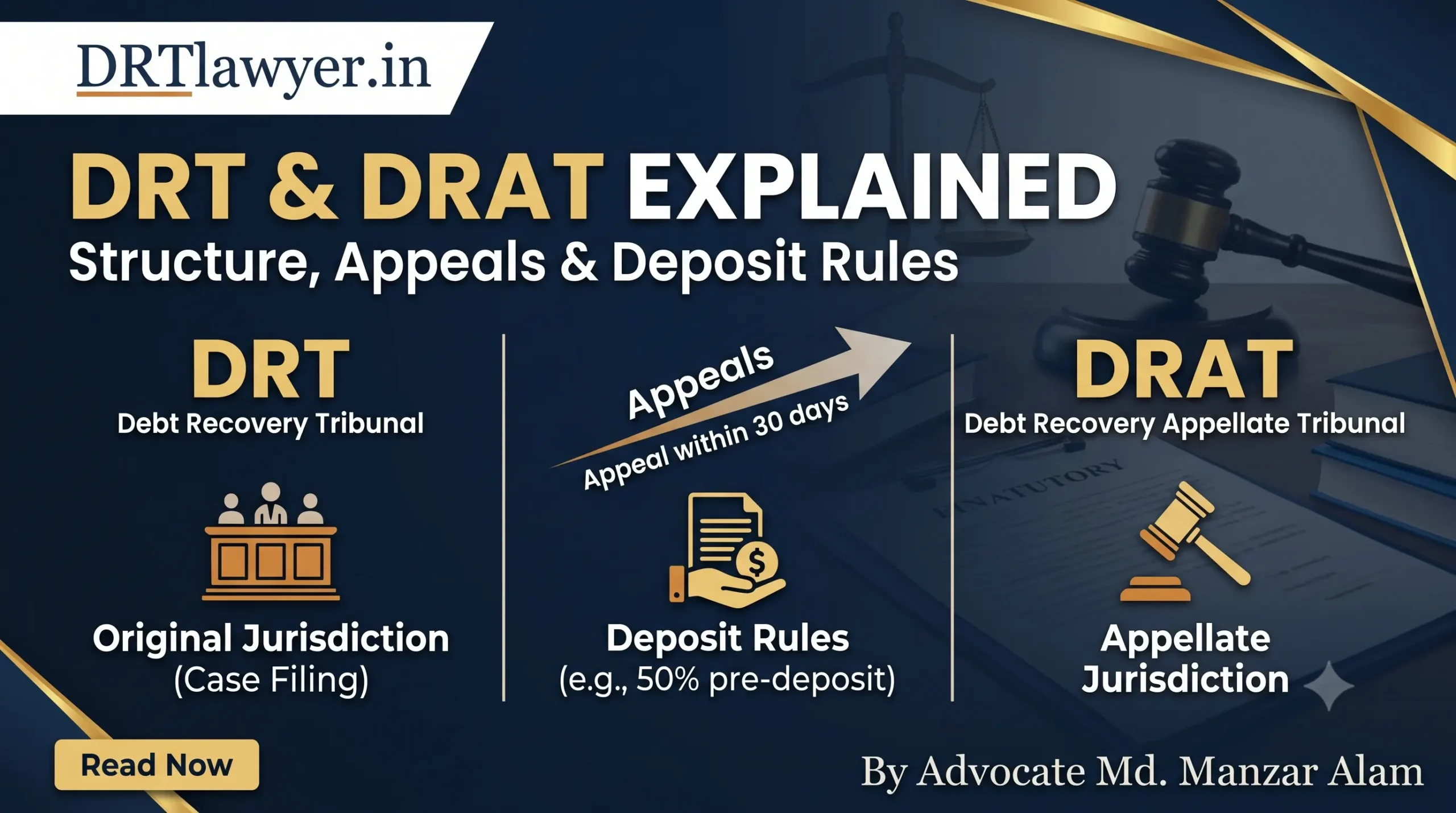
A bank has obtained an order from the Debt Recovery Tribunal. The Recovery Officer has attached your property. Alternatively, you have received a SARFAESI notice and want to challenge the bank's action. In each situation, a different legal provision applies. Missing the correct forum or filing deadline can result in dismissal, continued recovery proceedings, or even the loss of valuable rights.
This article explains the meaning of DRT and DRAT, their structure and hierarchy, the applicable appellate process, limitation periods, deposit requirements and the forums relevant to matters arising in Patna and other parts of Bihar.
DRT means Debt Recovery Tribunal. It is the primary tribunal for recovery of debts due to banks and financial institutions and also decides challenges to enforcement measures taken under the SARFAESI Act.
DRAT means Debt Recovery Appellate Tribunal. It is the statutory appellate forum above a DRT for appeals against DRT orders under the Recovery of Debts and Bankruptcy Act, 1993 and the SARFAESI Act, 2002.
The usual hierarchy is:
As per the Department of Financial Services, 39 DRTs and five DRATs are presently functioning in India. Each DRT is headed by a Presiding Officer, while each DRAT is headed by a Chairperson.
A visual representation of the appellate structure under the RDB Act and SARFAESI Act.
A Debt Recovery Tribunal, or DRT, is a specialised quasi-judicial tribunal established under the Recovery of Debts and Bankruptcy Act, 1993, formerly known as the Recovery of Debts Due to Banks and Financial Institutions Act, 1993.
Its principal purpose is to provide a faster forum for adjudicating and recovering debts due to:
A DRT can determine the amount legally due, issue a Recovery Certificate and authorise coercive recovery measures through its Recovery Officer.
The current pecuniary threshold for filing an ordinary bank debt-recovery application before a DRT is ₹20 lakh, in accordance with the Finance Ministry notification dated 6 September 2018. The applicable threshold and transitional provisions should always be checked before filing.
A Debt Recovery Appellate Tribunal, or DRAT, is the appellate tribunal constituted under the RDB Act to hear appeals against orders passed by a DRT.
A DRAT can:
DRAT is not a civil court and is not "above" the constitutional courts. It is a specialised appellate forum under debt-recovery legislation. After the DRAT passes its order, a party may explore constitutional remedies under Articles 226, 227 or 136 of the Constitution, but there is no routine statutory "third appeal".
At present, the five DRAT benches are located at:
The RDB Act governs:
Under Section 18 of the RDB Act, civil courts cannot ordinarily entertain matters over which the DRT or DRAT has jurisdiction.
The Securitisation and Reconstruction of Financial Assets and Enforcement of Security Interest Act, 2002, commonly called the SARFAESI Act, allows secured creditors to enforce security interests without first obtaining an ordinary civil decree.
Its principal provisions include:
A person aggrieved by measures taken under Section 13(4) must ordinarily approach the DRT under Section 17 within 45 days from the date on which the measure was taken. An appeal against the DRT's order under Section 17 lies to the DRAT within 30 days from receipt of the order.
For insolvency proceedings concerning personal guarantors to corporate debtors, the DRT functions as the Adjudicating Authority under Part III of the Insolvency and Bankruptcy Code.
This should not be confused with the insolvency of the corporate debtor itself. Corporate insolvency resolution proceedings ordinarily go before the National Company Law Tribunal, or NCLT, followed by the National Company Law Appellate Tribunal, or NCLAT.
Presiding Officer: Heads the Tribunal and decides original recovery applications, SARFAESI applications, interim applications, appeals against Recovery Officer's orders, and other matters assigned under the RDB Act.
Registrar: Manages the administrative and judicial-support functions of the Tribunal, including listing, scrutiny, records and procedural directions.
Recovery Officer: Executes the Recovery Certificate issued by the Presiding Officer. Depending on the statutory provisions, recovery may involve attachment and sale of movable/immovable property, appointment of a receiver, arrest and detention in civil prison in legally permissible cases, and other recovery modes prescribed by law.
Supporting Staff: The Registry includes ministerial and clerical personnel who manage filings, service, cause lists, records and court-fee processes.
A DRAT is headed by a Chairperson. It has a registry and supporting officers responsible for receipt of appeals, scrutiny, listing, service and records.
Apart from deciding appeals, the Chairperson of a DRAT also has limited supervisory powers under Section 17A of the RDB Act. This is not an ordinary appeal. It is an exceptional power that may be exercised where a DRT has failed to exercise jurisdiction or has acted illegally or with material irregularity.
| Nature of Matter | First Forum | Appellate / Remedial Forum |
|---|---|---|
| Bank or financial institution seeks recovery | DRT through an Original Application | DRAT under Section 20 of the RDB Act |
| DRT passes a final or interim order capable of appeal | — | DRAT |
| Recovery Officer passes an order | Appeal lies to the DRT under Section 30 | A subsequent DRT order may be examined under Section 20, if maintainable |
| Borrower or aggrieved person challenges SARFAESI enforcement | DRT under Section 17 of SARFAESI | DRAT under Section 18 |
| Challenge to District Magistrate or CMM order under Section 14 SARFAESI | District Judge under Section 17A | DRAT under Section 18A |
| Personal-guarantor insolvency matter | DRT under applicable provisions | DRAT under the applicable framework |
| Final DRAT order | — | Constitutional remedy before the appropriate High Court or Supreme Court |
The statutory timelines are strict. Under the RDB Act, an appeal against a DRT order must ordinarily be filed within 30 days from receipt of the order. An appeal against a Recovery Officer's order must ordinarily be filed before the DRT within 30 days. The appellate authority may consider a delayed filing only where sufficient cause is established.
The expression "DRT appeal" is often used loosely. Legally, it may refer to three different proceedings.
Under Section 30 of the RDB Act, a person aggrieved by an order of the Recovery Officer may appeal to the DRT within 30 days from the date on which the order was issued.
This is commonly confused with a DRAT appeal. If the Recovery Officer has attached or sold property, the immediate statutory appeal ordinarily lies before the DRT and not directly to the DRAT.
Section 30A separately prescribes a deposit requirement. The statute specifies 50% of the debt due as determined by the DRT.
Under Section 20 of the RDB Act, a person aggrieved by an order of the DRT may appeal to the DRAT.
Under Section 18 of the SARFAESI Act, an appeal lies to the DRAT against a DRT order passed under Section 17.
This is the primary meaning of a DRT appeal in common usage.
A Section 17 SARFAESI application is technically filed before the DRT to challenge measures already taken by the secured creditor. It is not the same as a first appeal, but it is a statutory remedy against enforcement action.
A borrower cannot ordinarily treat every Section 13(2) demand notice as an immediately appealable order. The SARFAESI framework generally requires the challenge to be connected with enforcement action taken under Section 13(4).
The following is the general appellate process under the RDB Act and the SARFAESI Act.
Download the order from the official e-DRT portal or obtain a certified copy. Preserve proof of the date on which the order was received, emailed, displayed or otherwise served. Do not calculate limitation merely from the date of pronouncement unless that is the legally relevant date.
Check: Whether the order is final, interim or procedural; whether it was passed with the consent of the parties; whether the appellant is a "person aggrieved"; which DRAT has territorial jurisdiction; and whether a special provision applies under SARFAESI or the IBC. Under Section 20(2) of the RDB Act, no appeal lies to the DRAT against an order made by the DRT with the consent of the parties.
For a RDB Act appeal, the borrower or person from whom the debt is due must ordinarily deposit 50% of the amount determined by the DRT. The DRAT may reduce this amount for recorded reasons, but the deposit cannot be reduced below 25%.
For a SARFAESI appeal under Section 18, the borrower must ordinarily deposit 50% of the amount claimed by the secured creditor or determined by the DRT, whichever is less. The DRAT may reduce the amount for recorded reasons, but not below 25%.
The deposit requirement is substantive and can determine whether the appeal is entertained. It should not be confused with court fees.
An appeal should not simply repeat the defence taken before the DRT. It should identify legal or factual errors, such as: lack of jurisdiction, violation of natural justice, failure to consider material evidence, reliance on inadmissible or irrelevant material, contradiction with binding precedent, procedural non-compliance under SARFAESI, an illegal or excessive Recovery Certificate, failure to decide a material issue, or an order that is arbitrary, perverse or legally unsustainable.
Depending on the applicable rules and current e-DRT practice, the filing may require: appeal memo, copy of the impugned order, proof of deposit, Vakalatnama or authorisation, affidavit and verification, memo of parties, relevant documents and exhibits, payment of prescribed fees, application for condonation of delay (if required), and application for interim stay (where necessary).
Filing an appeal does not automatically stop recovery or execution. If the Recovery Officer is proceeding with attachment, auction or possession, the appellant should ordinarily seek an express interim stay. The Tribunal will consider factors such as: prima facie case, balance of convenience, irreparable injury, the extent of deposit made, conduct of the parties, and public interest in recovery of public money.
After notices, pleadings and documents are complete, the DRAT hears the appeal. It may dismiss the appeal, allow it, modify the DRT's order, set it aside or remand the matter. The DRT and Recovery Officer must give effect to the appellate order. Where a Recovery Certificate has been issued, appropriate consequential action may be required under the relevant provisions of the RDB Act.
A Recovery Officer's order is not directly appealed to the DRAT in the first instance.
Example: A bank obtains a Recovery Certificate from the DRT. The Recovery Officer attaches a residential property in Patna and orders further recovery measures. The affected person must ordinarily file an appeal before the DRT under Section 30 of the RDB Act within the prescribed period.
The DRT may confirm, modify or set aside the Recovery Officer's order made under Sections 25 to 28 of the Act. If a party is thereafter aggrieved by a legally appealable DRT order, the question of a further appeal to the DRAT must be examined separately.
This distinction is critical because filing a Section 30 appeal directly before the DRAT can cause delay and procedural complications.
| Proceeding | Ordinary Limitation Period |
|---|---|
| Appeal against DRT order under RDB Act | 30 days from receipt |
| Appeal against DRT order under SARFAESI | 30 days from receipt |
| SARFAESI application under Section 17 | 45 days from the enforcement measure |
| Appeal against Recovery Officer's order | 30 days from issuance of the order |
| Appeal against DM/CMM order under Section 17A SARFAESI | 30 days from receipt |
| Appeal against District Judge under Section 18A SARFAESI | 30 days from receipt |
The statutory expression may refer to receipt, issuance or the date of the enforcement measure. These are not always the same date. Limitation must therefore be calculated from the correct legal starting point.
A DRAT order is ordinarily the final order under the relevant debt-recovery statute.
A dissatisfied party may consider:
However, these are constitutional remedies rather than routine statutory appeals. Constitutional courts generally require exceptional circumstances where an effective statutory remedy exists or has not been properly pursued.
The Supreme Court in United Bank of India v. Satyawati Tondon, (2010) 8 SCC 110, emphasised that where an effective remedy exists before the DRT under Section 17 of the SARFAESI Act, High Courts should ordinarily be slow to entertain a writ petition bypassing the statutory mechanism.
For borrowers, guarantors, banks and other parties connected with Patna or other districts of Bihar, DRT Patna is the principal Debt Recovery Tribunal for eligible matters arising in Bihar.
Under the current appellate-bench mapping, appeals from DRT Patna ordinarily lie before DRAT Allahabad.
Territorial jurisdiction should nevertheless be examined carefully in cases involving:
The e-DRT system provides facilities such as online filing, digital payments, case-status tracking, access to documents and hybrid or online hearings. The Department of Financial Services has reported that e-filing modules, Bharat Kosh integration and e-Sewa Kendras have been implemented across DRTs and DRATs.
Parties should regularly check the official portal, cause list and registered email address because statutory provisions permit electronic communication and website publication in prescribed circumstances.
Court: Supreme Court of India
Year: 2004
Citation: (2004) 4 SCC 311
Issue: The constitutional validity of important provisions of the SARFAESI Act and the adequacy of the remedy before the DRT were challenged.
Decision/Principle: The Supreme Court upheld the broad constitutional validity of the SARFAESI framework. It recognised the need for expeditious recovery of non-performing assets but struck down the earlier requirement of a 75% pre-deposit for a Section 17 application, holding it unreasonable and arbitrary in the form then existing.
Why It Matters: This judgment established that borrowers and aggrieved persons must have a meaningful opportunity to challenge enforcement action before the DRT. It should not, however, be misunderstood as removing the current statutory deposit requirements for appeals to the DRAT, which were subsequently legislated separately.
Court: Supreme Court of India
Year: 2010
Citation: (2010) 8 SCC 110
Issue: Whether a writ petition should be entertained by a High Court when the aggrieved person had an effective remedy under Section 17 of the SARFAESI Act.
Decision/Principle: The Supreme Court held that the statutory remedy before the DRT should ordinarily be pursued. High Courts should exercise caution before interfering with debt-recovery proceedings when Parliament has created a specialised statutory mechanism.
Why It Matters: The judgment reinforces the DRT–DRAT hierarchy and discourages attempts to bypass the Tribunal system through writ jurisdiction in routine factual disputes.
Before filing, confirm the following:
Even a strong appeal may fail if it is barred by limitation. The date of physical receipt, electronic service and portal publication should be checked immediately.
An appeal against a Recovery Officer's order ordinarily begins before the DRT. An appeal against a DRT order ordinarily lies before the DRAT.
An appeal or SARFAESI application does not automatically guarantee a stay. Separate interim relief may be necessary.
An appellate court expects the appellant to demonstrate error. Merely stating that the DRT's decision is "bad in law" is usually insufficient.
Failure to satisfy the statutory deposit condition can prevent the DRAT from entertaining the appeal.
Not every communication from a bank is a final appellate order. The stage of the SARFAESI action and the nature of the grievance must be examined carefully.
Parties should monitor the e-DRT portal and registered email address. An order may be served electronically in accordance with the Act.
The law has changed over time. Articles and judgments discussing the older 75% or 50% requirements must be read with the current statutory text.
Clear answers about DRT, DRAT, appeals, and deposit requirements.
DRAT means Debt Recovery Appellate Tribunal. It hears appeals against orders passed by Debt Recovery Tribunals under the RDB Act, the SARFAESI Act and related statutory frameworks.
A DRT decides original recovery matters and specified statutory challenges. A DRAT hears appeals against legally appealable DRT orders. A DRT is headed by a Presiding Officer, while a DRAT is headed by a Chairperson.
An appeal against a DRT order generally lies before the DRAT having territorial jurisdiction. For DRT Patna, the appellate forum is ordinarily DRAT Allahabad.
The ordinary limitation period is 30 days from the date of receipt of the DRT order. The DRAT may entertain a delayed appeal if sufficient cause is shown, but delay should never be assumed to be condonable.
Yes. Under the RDB Act, the relevant appellant must ordinarily deposit 50% of the amount determined by the DRT. The DRAT may reduce it for recorded reasons, but not below 25%. Under Section 18 of the SARFAESI Act, the reference amount is the lesser of the amount claimed by the secured creditor or determined by the DRT.
Yes. An appeal against an order passed by a Recovery Officer ordinarily lies before the DRT under Section 30 of the RDB Act, subject to the prescribed limitation and deposit provisions.
No. The appellant should ordinarily seek an express order staying recovery, auction, attachment, possession or other enforcement measures.
A direct writ petition is generally disfavoured where an effective remedy lies before the DRT under Section 17 of the SARFAESI Act. Constitutional remedies may still be available in exceptional cases, but they are not a substitute for the statutory process in routine disputes.
No. DRAT is the appellate tribunal under debt-recovery legislation. The High Courts and Supreme Court exercise constitutional jurisdiction. A DRAT order is not ordinarily followed by another statutory appeal, but constitutional remedies may be explored in appropriate cases.
The DRT functions as the Adjudicating Authority for personal-guarantor insolvency matters under Part III of the Insolvency and Bankruptcy Code. Corporate-debtor insolvency ordinarily proceeds before the NCLT.
If you are facing a bank recovery proceeding, SARFAESI enforcement, Recovery Officer action or a DRT appeal connected with Patna or Bihar, timely legal advice can help you identify the correct forum, limitation period, deposit requirement and available interim relief.
Founder – Sugam Tax & Legal Multiservices LLP | DRT Advocate Patna | Patna High Court
Bihar State Bar Council – Enrolment No. 3309/2010
Advocate Md Manzar Alam is the Founder of Sugam Tax & Legal Multiservices LLP. Through his professional practice and websites, he provides legal guidance and assistance in areas including banking, debt recovery, SARFAESI, taxation and related civil and commercial disputes.
With an MBA + LL.B. dual qualification, he brings a rare perspective to DRT and SARFAESI matters — understanding business, finance, and management alongside the letter of the law. He regularly appears before the Patna High Court, Debt Recovery Tribunal (DRT) Patna, DRAT, and all district courts across Bihar.
Choose how you'd like to connect. For personal litigation, reach Advocate Manzar Alam directly. For firm-level services — tax, property, documentation — contact Sugam Tax & Legal Multiservices LLP.
DRT Advocate Patna | Patna High Court | SARFAESI & NPA Lawyer Bihar
Full-Service Law Firm | Advisory & Documentation
Legal Disclaimer: This article is intended for general informational and educational purposes only and should not be considered legal advice. Laws, regulations, notifications and judicial interpretations may change, and the application of law depends on the facts and circumstances of each matter. Readers should consult a qualified legal professional for advice relating to their specific situation.